An Italian Story That Started With a French Failure
Most car brands have origin stories rooted in ambition. Alfa Romeo’s begins with a failure.
In 1906, a French company called Darracq opened an Italian subsidiary in Naples, hoping to tap into the growing Italian car market. It struggled almost immediately — the distance between Naples and the French headquarters made operations nearly impossible. By 1910, a group of Milanese investors, including entrepreneur Ugo Stella, took over the failing factory in Milan and gave it a new name: A.L.F.A, which stands for Anonima Lombarda Fabbrica Automobil — in English, the Lombardy Automobile Manufacturing Company. The Car Expert
The first car to roll out under the new name was the Alfa 24HP. It was followed by increasingly powerful models, and the company quickly found its identity in something that would define it for the next century: speed.
When the First World War broke out, the factory was converted to produce military equipment, and a Neapolitan engineer named Nicola Romeo was brought in to run it. When the war ended, Romeo took control of the company entirely. In 1920, the name changed one final time — A.L.F.A. became Alfa Romeo, and the brand we know today was born.
A Logo That Tells You Everything Before You Even Drive It
Most car logos are abstract shapes designed by marketing committees. Alfa Romeo’s logo is a 900-year-old piece of Milanese history.
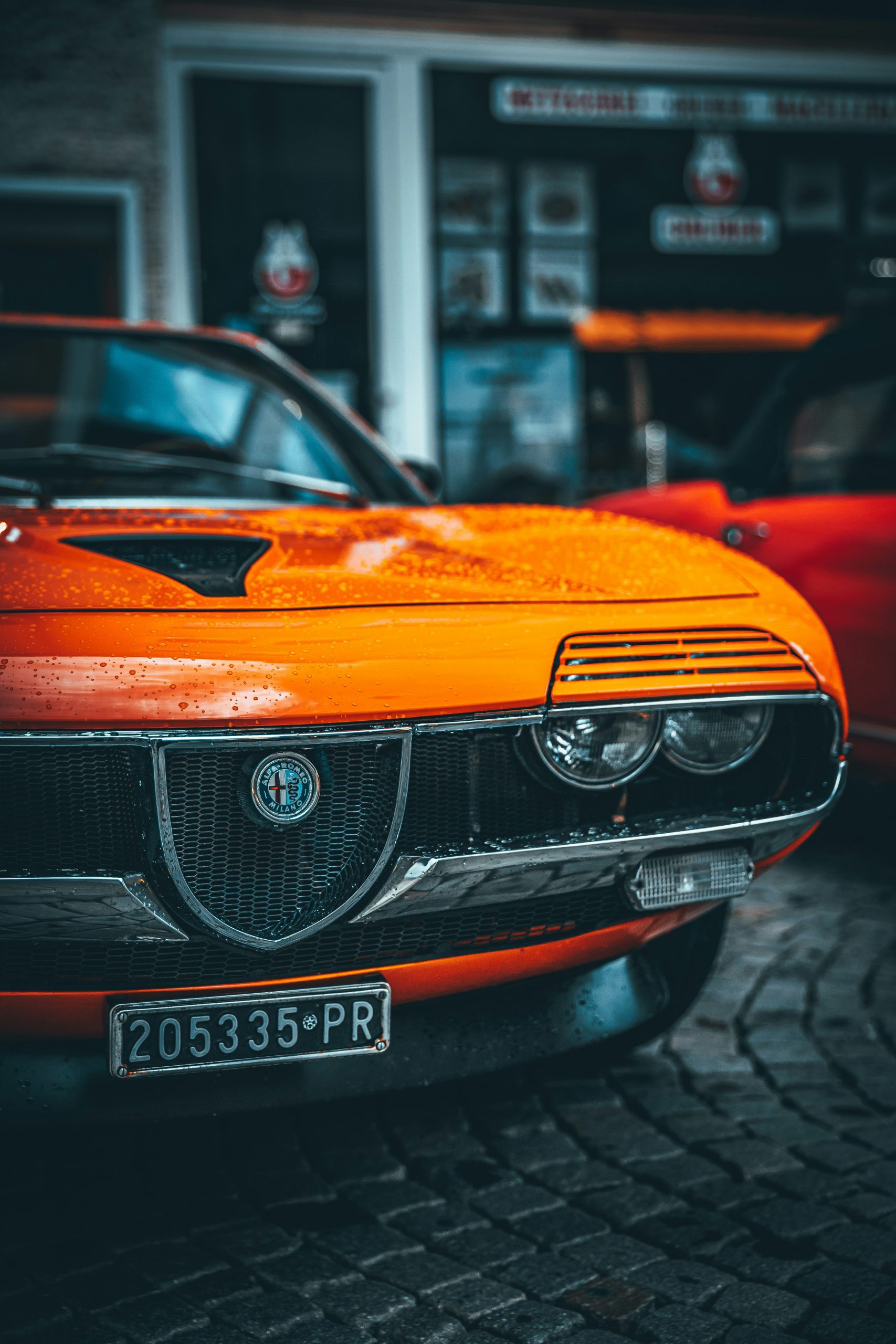
Since 1910, the Alfa Romeo emblem has included two symbols that identify Milan: the cross, the historical symbol of the capital of Lombardy, and the Biscione serpent, the coat of arms of the noble Visconti family — one of the city’s most iconic emblems for nearly a millennium. DS Automobiles
The idea came from a young illustrator named Romano Cattaneo, a friend of the company’s first chief engineer, Giuseppe Merosi. For over sixty years, the word “MILANO” was written directly on the badge itself, a permanent declaration of where the car came from and what that meant.
This is the first clue to what makes Alfa Romeo different. The brand has never tried to be a global, placeless product. It is, and has always been, unapologetically from Milan — and proud of it.
Win on Sunday, Sell on Monday — Decades Before It Was a Slogan
In 1923, Alfa Romeo achieved its first defining motorsport result. Driver Ugo Sivocci won the Targa Florio — one of the most demanding road races in the world, run on twisting Sicilian mountain roads — in an Alfa Romeo RL. It was the first of ten Targa Florio victories for the brand.
But the most important part of this story isn’t the trophy. It’s what happened next: the technology developed for racing didn’t stay on the track. Alfa Romeo’s engineers took what they learned from competition and built it directly into the cars customers could buy and drive every day.
Models like the Giulia Sprint GT, the Montreal, and the GTV weren’t just stylish — they carried genuine racing-derived engineering in their engines, suspension setups, and chassis design. This created something unusual for the era: road cars that gave ordinary drivers a taste of what a race car driver experienced. Performance wasn’t a marketing claim. It was inherited directly from the track.
This single decision — that racing success had to translate into road cars — became the foundation of everything Alfa Romeo stands for.
The Brand That Created Enzo Ferrari
Here is a detail that surprises most people: before there was a Ferrari, there was Alfa Romeo.
In the years after the First World War, Alfa Romeo’s racing program attracted some of the best drivers in Italy — including a young man named Enzo Ferrari. Ferrari raced for Alfa Romeo, and later managed the brand’s racing division, Alfa Corse, before eventually leaving to start his own company.
Think about what that means. The brand that would become the ultimate symbol of Italian automotive prestige and exclusivity was, in a very real sense, trained by Alfa Romeo. The DNA of one of the most famous car companies in history runs directly through Alfa’s early racing program.
Style Built by the Names Behind Every Iconic Italian Car
By the mid-20th century, Alfa Romeo had developed a relationship with two design houses that would go on to define what “Italian car design” even means: Bertone and Pininfarina.
These weren’t just contractors styling sheet metal. Together, they created cars that combined beauty with function, where Italian design focused on emotional appeal and practicality. The Giulia Sprint GT’s proportions, the Montreal’s dramatic louvered headlights, the GTV’s sculpted curves — these weren’t accidents. They were the result of some of the most respected design studios in automotive history treating Alfa Romeo as a canvas for ideas that would later influence Ferraris, Lamborghinis, and Maseratis. Ron Lewis Alfa Romeo
The 1960s in particular became a defining decade. The Giulia, with its sharp, aerodynamic lines, set new standards for what a performance sedan could look like — and the Tipo 33 Stradale, a sports prototype derived directly from Alfa’s racing program, became one of the most visually striking cars ever built, with victories at races like the Targa Florio reinforcing the brand’s identity all over again.
The Difficult Years — and Why the Fans Never Left
No honest story about Alfa Romeo skips the hard parts.
For long stretches of its history, particularly around the turn of the millennium, Alfa Romeo struggled to make money. Some of its cars during this period were, by the brand’s own historical standards, forgettable. The company also developed a reputation — fair or not — for rust issues during the era when Fiat owned it, a stain that took years to fade.
In 1986, the Italian government sold Alfa Romeo to the Fiat Group. In 2014, it became part of Fiat Chrysler Automobiles, and since 2021 it has operated under Stellantis, the massive automotive group that also owns Jeep, Peugeot, and Citroën.
By most rational business logic, a brand with this much financial instability and these reputation problems should have faded into obscurity decades ago. It didn’t. And the reason why is the most important part of this entire story.
“Because It’s an Alfa…” — The Phrase That Explains Everything
There’s a word for Alfa Romeo’s most devoted fans: Alfistas. And there’s a phrase Alfistas use that, more than any spec sheet or sales figure, explains why this brand has survived everything thrown at it.
Devotees of the marque will tell you that owning an Alfa Romeo is special “because it’s an Alfa” — full stop, no further explanation needed or wanted. The Car Expert
This is not the kind of loyalty you can manufacture with advertising budgets. It’s the kind that survives a company changing owners four times, surviving rust scandals, and going through years where the lineup wasn’t particularly exciting. Alfa Romeo built an emotional relationship with its customers so strong that the logic of “does this car make financial sense” simply stopped applying for an entire community of buyers.
A Car Named After Its Own Hometown
In 2024, Alfa Romeo unveiled its first Sport Urban Vehicle — essentially a compact SUV — and the name they chose says everything about how this brand thinks about itself even today.
They called it the MILANO.
The name encapsulates the brand’s history — a clear tribute to its hometown, ambassador of Made in Italy around the world, international capital of design, symbol of innovation and sustainability. Over a century after the word “MILANO” first appeared on the badge itself, Alfa Romeo went right back to that exact word to introduce its vision of the future, including its first steps into an all-electric lineup. DS Automobiles
That’s not a coincidence. That’s a brand that, even while building its first electric vehicles, refuses to let go of the one thing that has always set it apart.
More Than a Car Brand
Most car manufacturers are, at their core, manufacturing companies that happen to make cars. Alfa Romeo has always been something different — a company whose entire identity is built on the emotional, the artistic, and the historical, with the engineering serving that identity rather than the other way around.
The badge tells a 900-year-old story about a city. The racing program created the man who founded Ferrari. The design language influenced an entire industry’s idea of what Italian style means. And through bankruptcy, ownership changes, rust complaints, and decades of financial struggle, the fans never stopped saying the same four words: because it’s an Alfa.
In an industry obsessed with quarterly numbers and platform-sharing efficiency, Alfa Romeo remains proof that a car company can survive — and thrive — on something that can’t be put on a spec sheet at all.
Driving an Alfa Romeo is about feeling every detail of the road — including what your headlights show you on it. SEALIGHT LED upgrades drop straight into your factory housing, delivering daylight-level brightness with zero wiring and no cutting. A small upgrade that matches the passion behind the car. → [Check SEALIGHT pricing]

Leave a Reply