
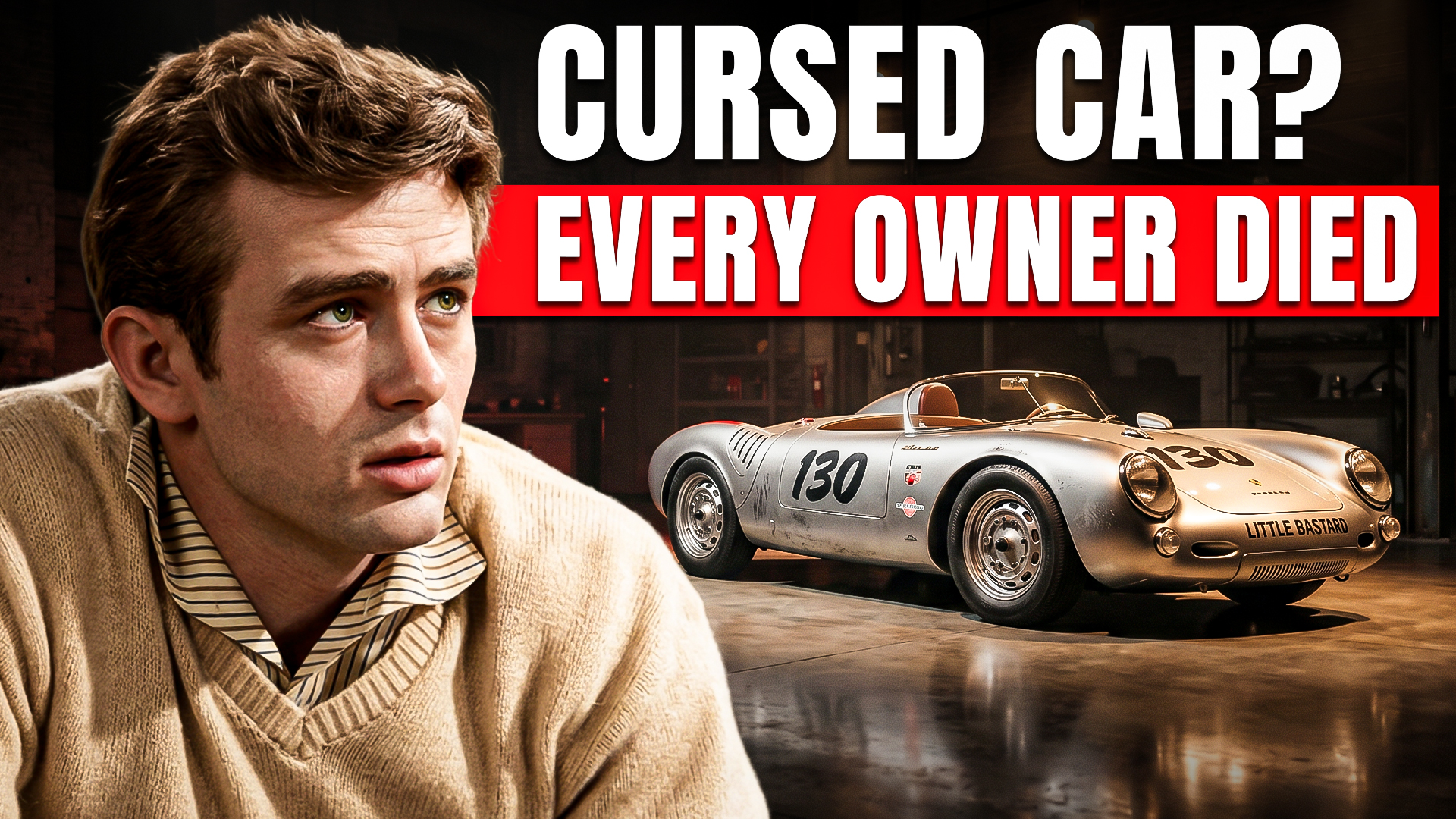
Most cars have a story. This one has seven.
In the video above, we walk through the full timeline of the Porsche 550 Spyder known as “Little Bastard” — the car James Dean was driving when he died, and the trail of strange incidents that followed it for years afterward. But before you watch, there’s some context worth having, especially around what’s actually documented versus what became legend over time.
A Race Car That Happened to Be Street Legal
James Dean’s career as an actor and racing driver was cut tragically short on September 30, 1955, but the car itself had a story before he ever sat in it. Hagerty
The Porsche 550 Spyder was built between 1953 and 1956, with only 90 ever produced. It wasn’t designed as a road car that could occasionally be raced — it was the opposite. A race car that happened to be street legal. The car was so low to the ground that a German Formula One driver reportedly drove one under a closed railroad crossing gate during the 1954 Mille Miglia.
Dean had been racing for less than a year when he traded in his Porsche Speedster for the 550. He had it for just over a week before the fatal crash. Dyler
The Warning
This part of the story is genuinely documented, not embellished. A week before the crash, Dean met British actor Alec Guinness in Los Angeles. Guinness later wrote in his diary that the car looked sinister to him, and according to his own account, he told Dean something close to: if you get in that car, you’ll be found dead in it within a week. Hagerty Media
The prophecy proved chillingly accurate. History’s Vault
Dean had the car customized before the crash — the number 130 painted on the hood and doors, and “Little Bastard” painted across the rear. The name itself has a slightly disputed origin; some say it was a jab at a Warner Bros. executive who didn’t want Dean racing, others say it was just Dean’s own nickname among friends.
What the Video Covers
The video goes deep into what happened after the crash — and this is where the story shifts from tragedy into something much harder to explain rationally.
The wrecked Porsche’s parts didn’t just disappear into a scrapyard. The engine ended up in another race car. The transmission ended up in a different one. Both cars were in the same race less than a year later, and the results were not good for everyone involved. Troy Lee McHenry’s Porsche, fitted with parts from Dean’s wreck, hit the only tree on the track on the first lap of the 1956 Pomona races. Motorious
From there, the story gets stranger — a touring safety exhibition, a fire, a fatal accident involving the truck driver hauling the wreck, and eventually a disappearance that, six decades later, still has no real explanation.
Fact vs. Legend
Here’s the part that doesn’t always make it into the more sensational retellings: a lot of what people “know” about this story comes from one man — George Barris, the customizer who later became famous for designing the Batmobile.
Barris tirelessly promoted the notion that Dean’s 550 was cursed, and his 1974 memoir is the source of most of the detailed curse narrative people repeat today. But researchers digging into the original records have found that several of his claims are demonstrably false, and some details — like who actually bought the wrecked carcass — don’t match what Barris claimed for decades. Motor Sport MagazineMotor Sport Magazine
That doesn’t mean nothing strange happened. The documented incidents — the deaths, the crashes, the tire blowouts, the disappearance — are real and verifiable on their own, without any embellishment needed. But it’s worth watching this story with the understanding that one man spent twenty years actively shaping how it would be told.
One More Number Worth Knowing
If you want a sense of how powerful this mythology became: a Porsche 550 with a serial number just five digits away from Dean’s — not the cursed car, not the famous one, just a sister chassis from the same production run — sold at auction in 2016 for $5.35 million.
The car itself is part of the story. But the legend James Dean and that Porsche created together on a September evening in 1955 became something neither could have created alone.
Watch the full for the complete timeline, including the disappearance that still hasn’t been solved. HERE
Leave a Reply