

The Rise of Godzilla
For eighteen years, the Nissan GT-R owned the drag strip. It made Ferraris look slow. It embarrassed Lamborghinis. It lapped the Nürburgring faster than a Porsche 911 Turbo and did it for half the price of a European exotic. They called it Godzilla. They called it a supercar killer. And then one tuned Toyota Supra, running on a thirty-year-old inline-six engine, lined up beside it — and the automotive world was never quite the same again.
The Monster That Started It All
To understand why one Supra beating a GT-R meant so much, you have to understand what the GT-R actually was.
Chief engineer Kazutoshi Mizuno initially rejected the R35 project, stating he could not build a world-class performance car from the outdated platform proposed. He constructed his own prototype, was granted full development authority, and what emerged in 2007 was something the automotive world had never seen at its price point.
The legendary RB engine was replaced by the VR38DETT — a 3.8-liter hand-built twin-turbo V6 mated to a dual-clutch transmission and cutting-edge all-wheel drive. It lapped the Nürburgring in 7 minutes and 38 seconds, faster than the Porsche 911 Turbo, becoming the fastest mass-produced car in the Green Hell. Power grew from 473 horsepower at launch to 562 in standard form and 600 in the NISMO version. It launched to 60 mph in 3.3 seconds for under $80,000. Nothing touched it.
What made the GT-R truly terrifying was not just straight-line speed — it was consistency. Any reasonably skilled driver could climb in, activate launch control, and produce supercar-level times on demand, repeatedly. You could not out-drive a GT-R with talent alone. You had to out-engineer it. And that is exactly what the Supra community set out to do.
The Engine That Should Not Have Been Able to Do This
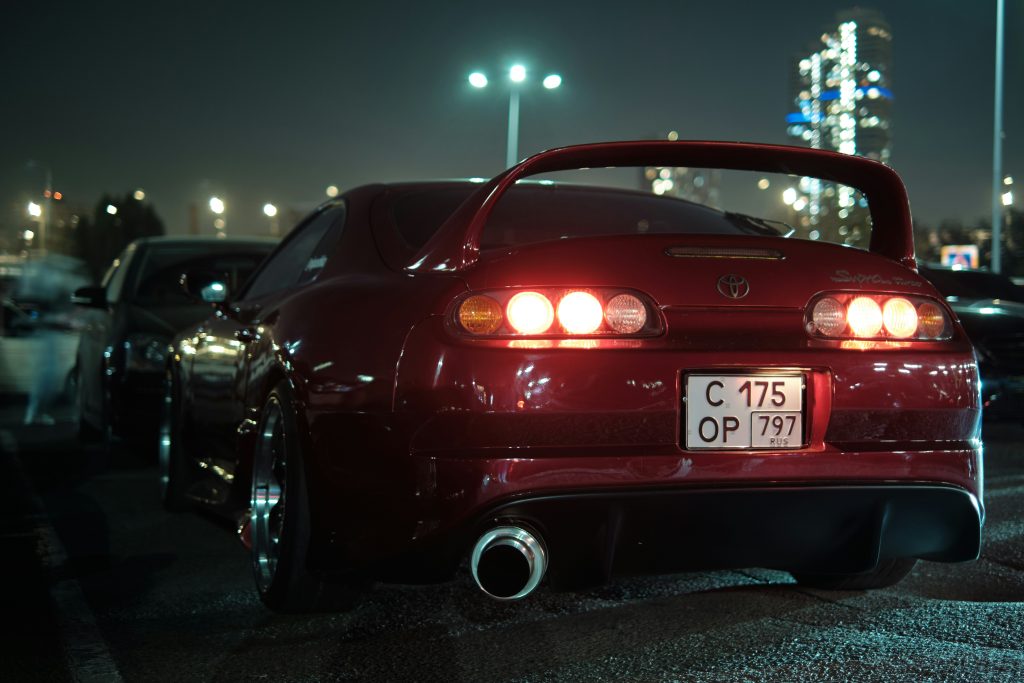
The A80 Toyota Supra entered production in April 1993. The twin-turbocharged 2JZ-GTE produced 321 horsepower and 315 lb-ft of torque from the factory. That is where the official story ends and the real story begins.
Toyota built the 2JZ with a closed-deck iron block, forged internals, oil squirters, and a beefy bottom end — all from the factory. The official 280 PS Japanese domestic rating was a gentleman’s agreement honored on paper while the cars shipped with significantly more. Independent dyno testing showed stock JDM Supra twin turbos making 320 to 330 PS at the crank.
In doing so, Toyota accidentally created the most tuneable engine platform in history.
With proper tuning, the 2JZ reliably produces 500 to 600 horsepower on stock internals. Upgraded builds exceed 1,000 horsepower routinely. Some have exceeded 2,000. The world record 2JZ-GTE surpassed 2,500 horsepower on a fully built aftermarket block. The street-driven record sits around 1,800 horsepower on a factory block — a staggering number for an iron lump designed in the 1980s.
The single-turbo conversion became the universal modification for serious builders. By replacing the complex sequential twin-turbo system with one large turbocharger, tuners discovered that the 2JZ’s cast-iron block could be pushed to levels that made its designers look conservative. On the right fuel with the right supporting modifications, 1,000 horsepower became not a record but a baseline.
When the Numbers Stop Making Sense
In one of the most iconic matchups in JDM drag racing history, an A80 Supra running a rebuilt 2JZ with a single turbo made 850 horsepower and weighed 3,086 pounds. The Nissan Skyline GT-R R34 it faced was similarly modified at 672 horsepower and 3,351 pounds.
The Supra had more power. The Supra weighed less. But the GT-R had all-wheel drive — and all-wheel drive off the line is a weapon that changes everything about a standing-start drag race.
From a rolling start, where traction is already established and the 2JZ’s power advantage can fully express itself, the Supra won after a photo finish. From a standing start, where the GT-R’s all-wheel-drive system could deploy its full traction advantage simultaneously, the Nissan destroyed the Toyota despite giving away 178 horsepower and 265 pounds.
This is not a failure of the Supra. It is a precise illustration of what all-wheel drive does at high power levels. The GT-R’s ATTESA E-TS Pro system was measuring wheelspin and calculating torque distribution in real time. Against a rear-wheel-drive car at the same power level, that system is an enormous advantage in the first hundred meters.
But the tuner community was not finished.
In another legendary matchup, a fully built 900 horsepower Supra — ironically painted Bayside Blue, the same color as the iconic R34 GT-R — lined up against an 800 horsepower GT-R. At those power levels, the gap between all-wheel drive and rear-wheel drive begins to close. The GT-R launched quicker and built a lead of around six car lengths. The Supra erased it entirely in the second half of the race. A dead tie. Six car lengths. Gone.
Why the GT-R Was Always Going to Lose This War
The GT-R’s genius was making an average driver fast. The all-wheel-drive system, launch control, dual-clutch transmission, and computerized torque distribution all existed to remove human error and deliver repeatable, devastating performance regardless of who was driving.
But what began at around $70,000 ballooned to over $120,000 by its final year. As the GT-R got heavier and more expensive, the tuner community was doing the opposite with the Supra — stripping weight, adding power, solving the traction problem with better tires and technique.
Approximately 11,000 A80 Supras were produced between 1993 and 2002. That rarity meant every surviving car was cherished and modified by people who genuinely loved the platform. The MK4 benefits from over 30 years of aftermarket development, with tuners worldwide pushing the same engine further than anyone thought possible.
The GT-R had the factory. The Supra had the community.
There is a specific reason the Supra community could push the 2JZ further than Nissan could push the VR38DETT. The GT-R’s engine was designed to serve the car’s computerized AWD system — its entire character was optimized to work within Nissan’s electronic management architecture. Tuning it aggressively meant working against that architecture, which limits the ceiling in ways the simpler, more analog 2JZ never faced. The 2JZ had no such constraints. It was a clean canvas. And thirty years of tuners treated it exactly that way.
In March 2025, Nissan closed the order books for the R35 after 18 years in production and roughly 40,000 units built. The GT-R is gone.
The 2JZ Outlasts Everything
The 2JZ engine that Toyota designed in the late 1980s is still being built, still being tuned, and still being raced. Heavily modified units have reached 2,041 horsepower. The engine has outlasted the car it was designed for. It has outlasted the production run of the GT-R that it spent decades battling on drag strips around the world.
The 2JZ became the face of the global engine tuning movement, bridging underground street racing and professional motorsport. It dominated video games, forums, and Hollywood films. The Fast and the Furious put an orange Supra on cinema screens in 2001 and introduced an entire generation to the idea that a Japanese inline-six could do things no manufacturer had ever advertised. Gran Turismo put the 2JZ in the hands of millions of virtual drivers before they ever sat in a real car.
The Supra MK4 won its class in Swiss Mountain Races. It competed at Le Mans. It charged up Pikes Peak. It dominated the All-Japan GT Championships from 1995 through 2003. The same engine tuners were building to 850 horsepower for drag racing was simultaneously powering professional race cars to championship titles.
One Supra beating one GT-R is not, by itself, a history-changing event. What makes the story larger than any single race is what it represents — the proof that a community working with thirty-year-old technology, driven by nothing but love for a platform, could build something capable of embarrassing the most sophisticated AWD supercar Japan ever produced.
The GT-R was built by a corporation with billions of dollars. The Supra that beat it was built in garages, on dyno rollers, and through thousands of hours of unpaid testing by people who refused to accept that newer meant faster.
The 2JZ is still being built. It is still being tuned. It is still showing up at drag strips where it has no business competing and leaving people speechless when it wins. The GT-R is gone. And the engine Toyota built in the 1980s is still here, still running, and still hungry.
See better on the road
Every serious car build starts with visibility. If you are upgrading your vehicle, SEALIGHT LED headlights deliver brighter, whiter light with plug-and-play fitment — no wiring required. Check compatibility and current pricing HERE
Leave a Reply